Get to Know Me Better
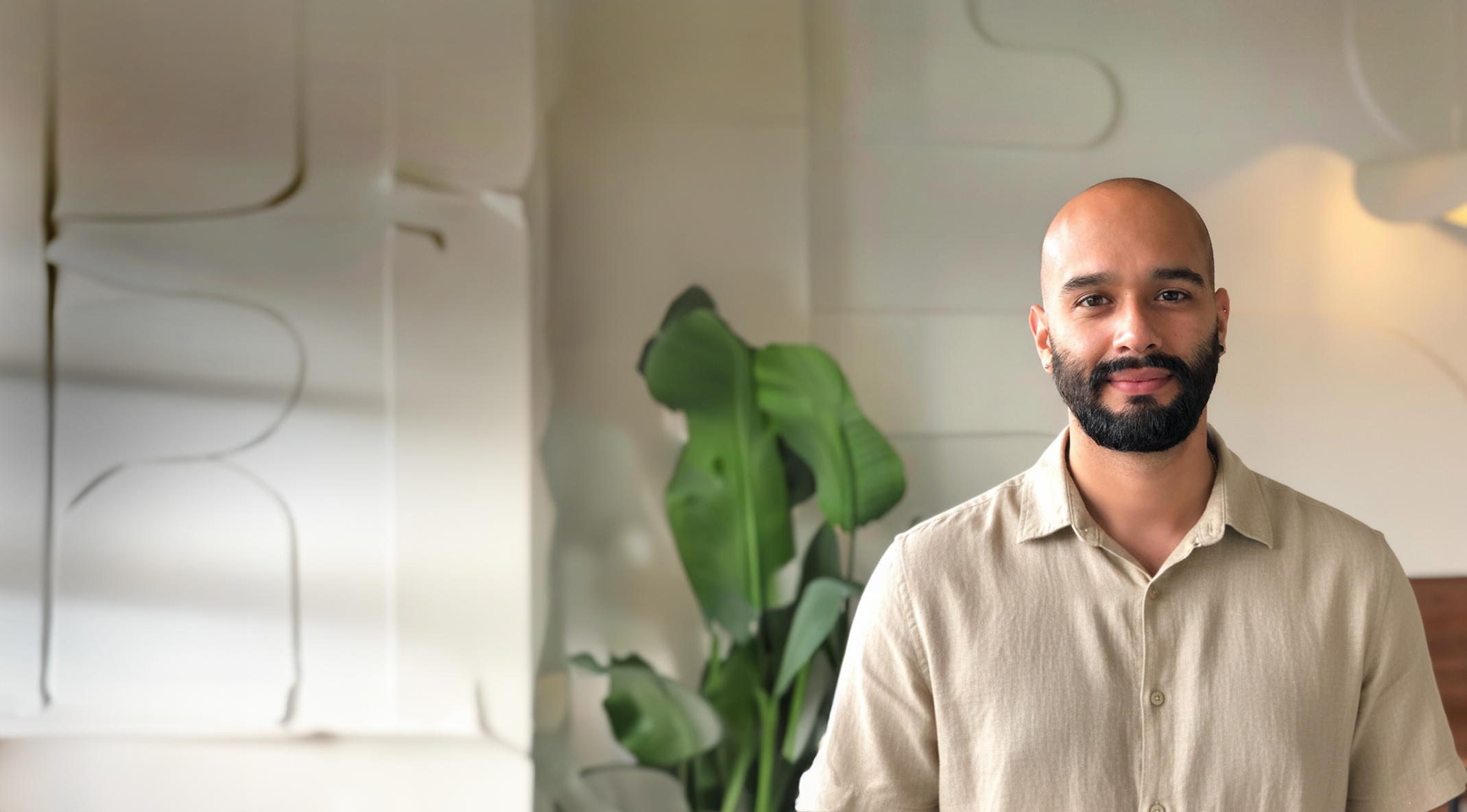
Andrés González
Who I Am & How I Work
You're here because something isn't working — and you've probably tried
to figure it out on your own for longer than you'd like to admit.
Maybe it's anxiety that won't switch off. A grief that has no clear shape.
A diagnosis that changed everything. A relationship that drains you.
Or simply the feeling that life is happening to you, rather than through you.
Whatever brought you here, this is a space for it.
I'm Andrés — a Colombian clinical psychologist and psychotherapist based in Frankfurt am Main, Germany. I work online, in four languages — Spanish, German, English, and Italian — with people across Europe and Latin America.
My clinical work spans psycho-oncology and anticipatory grief, anxiety, depression, burnout, complex trauma, borderline personality disorder, narcissistic relationship dynamics, and the particular challenges of building a life far from home.
I also work with people who aren't in crisis — but who want to understand themselves more deeply, strengthen their mental health, and build something
more meaningful going forward.
I work from a psychodynamic framework, integrating evidence-based approaches. My style is direct, warm, and honest. I don't believe in quick fixes or empty reassurance. I believe in actually understanding what's happening beneath the surface — and working with it carefully, respectfully, and without flinching.
Over more than ten years of clinical work — in Colombia, Italy, and Germany —
I've sat with people at some of the most difficult moments of their lives.
That experience taught me that what people need most is not a technique.
It's a space where they don't have to carry it alone.
If something in what you've read resonates — I'd like to hear from you.
-
In 2015, I walked into the dean's office at my university in Medellín with a plan:
take a semester off, go to New Zealand, learn English. He listened — and made a different offer.
An academic exchange at Sapienza Università di Roma.I said yes. That decision changed everything.
In Rome I worked as a research assistant under Dr. Tina Pastorelli — a scientist whose precision,
analytical rigor, and absolute commitment to knowledge left a permanent mark on me.
Her foundational work on the development of prosocial behavior, developed alongside Albert Bandura,
was my first real encounter with what serious science looks like from the inside.My closest friends in Rome were mostly German and international. English was the common language —
and I arrived with almost none. At the same time, every course at Sapienza was in Italian. So I learned both
simultaneously, under real pressure, because I needed them to function: academically and humanly.
That experience planted a fascination I've never lost — with how we think differently in different languages,
how another tongue opens a different relationship with your own interior, how understanding someone
in their language is already an act of care.My German friends sparked a curiosity about Germany — its academic culture, its rigor, its language —
that never left me. I didn't know then that I would eventually build my professional life there.Back in Colombia in the second half of 2016, I went directly into my clinical internship at the Consultorio
Psicológico Popular of Universidad San Buenaventura. Three semesters of direct clinical work, parallel
research, and supervision that shaped my clinical instincts at a foundational level.Two people defined that formation.
Dr. Juan José Martínez — a doctor in psychoanalysis — opened the Lacanian psychoanalytic tradition
to me and with it, a different way of understanding the human subject: the concepts of void and anxiety
not as pathology to be eliminated, but as structure to be understood.Mónica Schnitter Castellanos — whose work on primary relational dynamics and internal object relations
gave me the foundations of my psychotherapeutic style. Her precision of analysis and the depth of her clinical
approach are present in every session I conduct today.Then came the Master's in Clinical Psychology. And with it, the work that would redirect everything.
I arrived at the grief unit of Funeraria San Vicente in Medellín in January 2020.
Two months later, the city locked down.There was a curfew. No one could leave. Inside those walls, I kept showing up — sitting with families who had
just lost someone: children, grandparents, adults. Many of them to cancer.One family I will never forget. Their son was 14 years old. He had been diagnosed with lymphatic cancer at an
advanced, terminal stage — no cure, no more time. The psychological support I offered that family, the ritual,
the goodbye — it marked something in me permanently. Not as trauma. As direction.That experience became the foundation of my Master's thesis on grief processes. And it planted a question I've
carried ever since: what happens to a person — psychologically, existentially — when cancer enters their life?After completing my Master's, I spent a year and a half teaching at Institución Universitaria Tecnológico de Antioquia —
Social Psychology, Dynamic Psychology, Qualitative Research, and Educational Psychology, within the Faculty of
Education's psychology program. Teaching has always been inseparable from my clinical work.
Transmitting knowledge about the human mind — clearly, rigorously, accessibly — is something I genuinely love.
It sharpens my thinking and deepens my practice.Then came the decision to move to Germany.
Germany had been on my mind since Rome. In January 2023, I committed to making it real — seven months of
intensive German study, from zero to a level sufficient to interview in clinical settings. Language, for a psychotherapist,
is not a tool. It is the work itself. Every word a patient chooses carries meaning. Every silence has a shape.
I needed to hear that in German before I could be useful in it.It worked. In mid-2023 I moved to Frankfurt. And in July 2024, I started my first clinical position in Germany —
at Kaiserberg MEDIAN Klinik Bad Nauheim, a rehabilitation clinic specializing in orthopedic conditions, auditory
disorders, tinnitus, and vertigo. Working there until January 2026 gave me something I couldn't have learned
any other way: a deep, practical understanding of the German healthcare system, its structures, its clinical
culture, and its demands. My work was entirely in German, with German patients, within German institutional protocols.
That immersion was the real foundation of my clinical practice here.During that same period, I was accepted into the Approbation als Psychotherapeut program in Psychodynamic
Psychotherapy at Universitätsmedizin Mainz — the formal path toward full licensure as a psychotherapist in Germany.And I kept pursuing the question from Medellín.
In 2025 I applied for a psycho-oncology position at the University Hospital in Frankfurt. I wasn't accepted.
I applied again. Still no. I stayed with the intention.In late 2025, I interviewed at Klinikum Hanau. They accepted me. I began in March 2026. I now work directly with
cancer patients — people in palliative care, people in remission, people living in the uncertainty in between.
Every session brings me back to that family in Medellín, and to the question I couldn't stop carrying: what does a
person need, psychologically, when life asks the hardest things of them?What moves me across all of this work — oncology, grief, anxiety, depression, relationships, the particular
loneliness of living far from home — is something I carried long before I entered any clinic.
Before studying psychology, I almost studied medicine. What made me change direction was a question
I couldn't stop asking: not what happens in the body, but why we think what we think, feel what we feel,
and how we can live better with both.There were moments in my own life where something difficult had no container, no witness, no name.
That experience, more than any training, taught me what it costs to carry something alone.My work, in every language and every context, is built on one intention: to make sure you don't have to.

Experience
-
2016 – 2021
Public Psychological Clinic -
San Buenaventura’s University
Medellín, Colombia
-
2019 – 2020
Funeraria San Vicente
Medellín, Colombia
2024 – 2026Kaiserberg MEDIAN Klinik
Bad Nauheim, Germany
2025 – todayOnline-Therapy
BetterHelp -
2020 – 2023
Psychology Teacher:
Dynamic Psychology,
Social Psychology,
Qualitative Research
Institución Universitaria
Tecnológico de Antioquia
Medellín, Colombia2023 – today
Lecturer:
Sport Psychology and CoachingFresenius Hochschule
Idstein, Germany
Main Education
-
Universidad San Buenaventura
Medellín, Colombia
Clinical and Research Internship
in Psychosomatics and Psychiatry
2013 – 2018
-
Sapienza Università di Roma
Rome, Italy
2016
-
Universidad San Buenaventura
Medellín, Colombia
Specialization in Clinical Diagnosis, Psychotherapy, Psychosomatics,
and Psychiatry
Research Thesis: Analysis of Grief Processes and their Psychological Impact
2019 – 2021
-
Berufsverband Deutscher Psychologen e.V. (BDP)
GermanyFocus on Clinical Psychology and Psychotherapy
2023

Clinical and
Continuing Education
2025 – today
Approbation als Psychotherapeut in progress
Universitätsmedizin Mainz –
Department of Psychosomatic Medicine
and Psychotherapy
Ausbildung in Psychodynamic Psychotherapy
2025
Tinnitus Symposium
Charité- Berlin
2025
Psycho-Oncology: Hands-on Introduction
Clinical Approach to Psychosomatic Patients
Continuing Medical Education (CME)
Applied Data Analysis
and Data Science
2025
University of Pennsylvania
Performance Evaluation,
Talent Management,
and Predictive Analytics
People Analytics
2025
Google
SQL, Excel, Data Analysis,
and Evidence-Based Decision-Making
Data Analytics